Rețele și parteneriate locale
2. Networking Plan and strategic aspects
2.3. Sharing Economy (Definition)
The term Sharing Economy (also "Shared Economy") means the systematic lending of objects and the mutual provision of objects, spaces and areas, in particular by private individuals and interest groups. The term "share economy" is used synonymously or - in addition to Martin Weitzman's original definition - in relation to the sharing of information and knowledge.
According to the idea of the economy of sharing, the buyer should not turn something into property, but should temporarily use, inhabit and manage it. The prerequisite for this is, of course, usually the ownership of a supplier. The focus is on collaborative consumption. The goods change hands as long as they are needed or available. Maintenance is usually the responsibility of the owner.
With electronic platforms and social networks one reaches a large circle of interested parties, can act and react at short notice and achieve optimal use and utilization. Some platforms are specialized in apartment sharing and land sharing, others enable variants such as book and jewellery sharing. Also exchange and gift exchanges belong to the hardly to be surveyed landscape. With the help of social media functions, demanders and suppliers are evaluated and vandalism and abuse are sanctioned.
The economy of sharing is viewed critically by the economy on the one hand, and used productively on the other. Car sharing, for example, is extremely popular in some countries and in the hands of cooperatives and companies. In addition, private cars are converted into public taxis and apps bring drivers and guests together. With regard to users, the criticism is that it is predominantly those who have access to the virtual world who also gain access to the Sharing Economy, which, with the terms of information ethics, means a digital divide or digital or informational injustice. With regard to the intermediaries, it is striking that they can shake entire industries through their platforms alone, without owning their own homes, vehicles, content, etc.. This "platform capitalism" (Sascha Lobo) can be addressed by information and business ethics. On the positive side, the environment is protected and consumption becomes more conscious and social. The Sharing Economy receives a boost in times of crisis; at the same time it should be an expression of the experience and fun society.
(Source: https://wirtschaftslexikon.gabler.de/definition/sharing-economy-53876)
Figure 5 : Change of Business Landscape
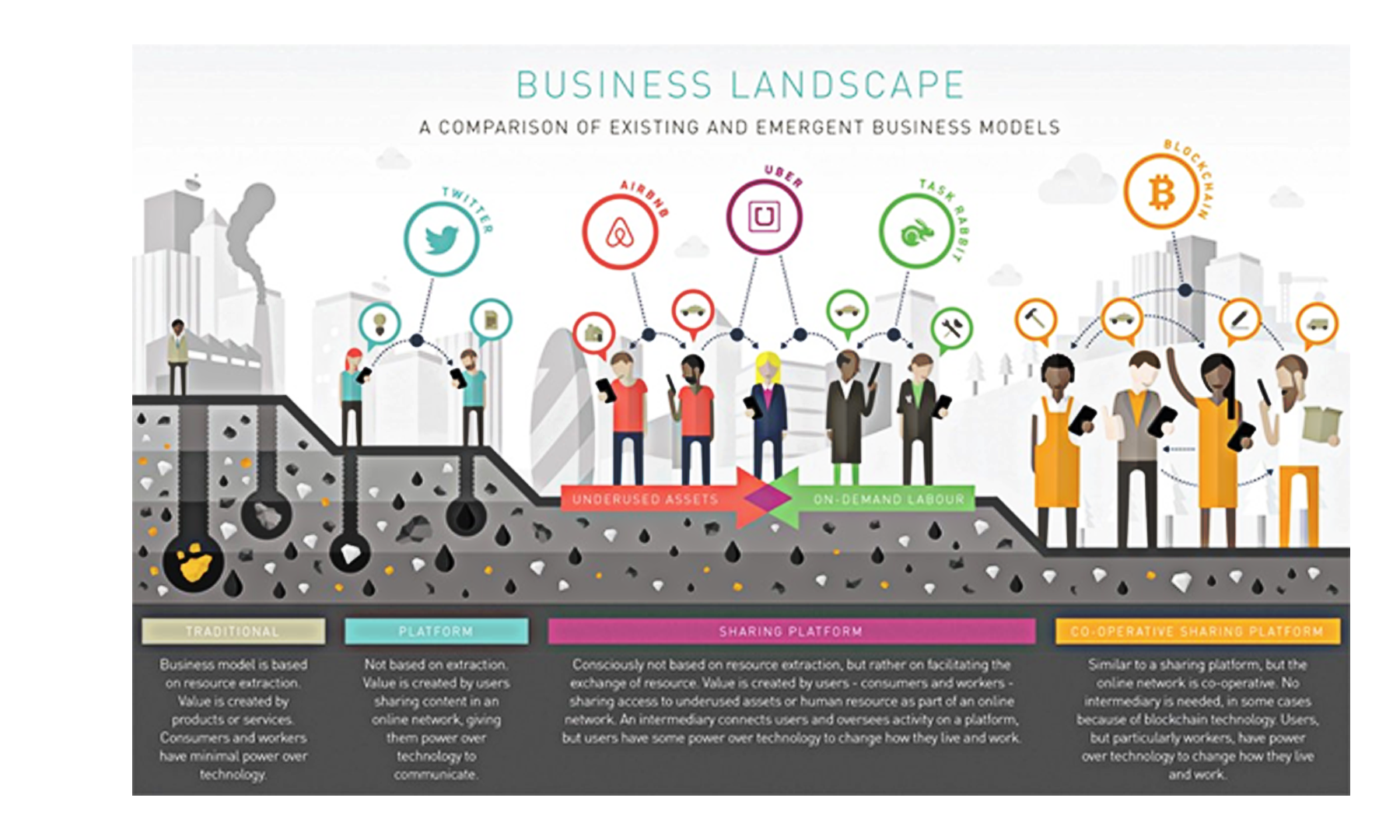
Source: https://medium.com/rsa-reports/fair-share-reclaiming-power-in-the-sharing-economy-499b46bd4b00
More information:
A cooperative is an autonomous association of persons united voluntarily to meet their common economic, social and cultural needs and aspirations through a jointly owned and democratically controlled enterprise.
Source: https://www.ilo.org/global/topics/cooperatives/lang--en/index.htm