Market research and framing the business idea
Learning outcomes
Knowledge
• Importance of consumers’ needs and competitors’ landscape
• The 4 P’s of marketing mix (product, price, promotion, place)
• Reading a simple balance sheet
• Pricing- breakeven point
• Methods of market research
Skills
• How to do market research
• How to develop a short business plan
• How to develop business identity
• How will they communicate their product service to the public
Competences
• Ability to assess a Cultural Heritage business idea
• Ability to present the Cultural Heritage business idea
| Site: | E-learning courses powered by IDEC |
| Course: | Social entrepreneurship through cultural heritage-CHEER - EN |
| Book: | Market research and framing the business idea |
| Printed by: | Guest user |
| Date: | Thursday, 8 October 2026, 7:39 AM |
Table of contents
1. The 4 Ps – Marketing Mix
In this first part of our online course we will familiarize you with the so-called marketing mix, the "4 P". This is actually nothing more mysterious. The marketing mix tries to briefly describe which aspects belong to marketing and what needs to be considered.1.1. What are the 4 Ps?
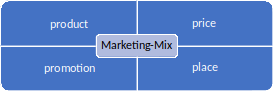
The "four Ps" describe the so-called marketing mix. The "P" stands for the English terms "product" (product or product policy), "price" (price or price policy), "place" (place or distribution policy) and "promotion" (marketing, communication policy).
Maybe you think that it should be self-evident that you need a product that has a certain price and that you sell at a certain place - and that you tell the target group about its existence so that they buy the product. True, that's actually quite logical. Nevertheless, behind each of these areas there is a whole mountain of considerations and decisions to be made. In the following, we will give you a brief overview of the individual "Ps" before we go into individual aspects in more detail.
1.2. Product policy
No company without a product. Of course, the product can also be a service - and also products do not have to be physical: An online course or an e-book are also products. In any case, the product is the basis of your entrepreneurial success. However, product policy generally includes all decisions and actions that are directly related to the product. Also:
- Which products (or only one?) do I offer?
- Product quality
- Services around the product
- packing
- Marking (i.e. under which brand the product should run)
In addition, questions about the breadth and depth of supply also belong to the area of product policy, especially in the area of innovation.
In terms of product breadth, there are two extremes: the generalist (a very broad range of products/services) and the specialist (highly specialized products/services are offered in a clearly defined segment).
In the area of Cultural Entrepreneurship, you will most likely be a specialist - usually it is a matter of niche products, which you can treat in depth due to special knowledge or special interest.
1.3. Pricing policy
Every product and every service has its price when you start a commercial business. The price policy obviously includes everything to do with the price. So it's not just about the "regular" price, but also about discounts, promotions, terms of payment, etc.
You always design the price with a view to your competitors, but of course also with a view to the costs you incur. You calculate these by including different components. These are above all:
- the material costs,
- Depreciation costs, i.e. the acquisition costs of buildings, machinery, vehicles, etc., spread over the useful life of the asset, are recognized in the income statement,
- labour costs,
- any usage fees for licenses, leased equipment, etc. (usage costs),
- Costs for trade, transport, storage, insurance services, etc. (service costs),
- Interest on loans (interest costs),
- Taxes and duties.
On these costs you then add the profit that you would like to achieve per product. Then you know at what price you would have to sell your product. Now it has to be checked whether it will also find a customer at this price.
To calculate your cost price, you can also use a template from the Internet. For example, there are pre-programmed Excel tables with which you can easily calculate this. If you have a little sense for numbers, you can also make a quick calculation. This is what most entrepreneurs do in practice when they first want to test whether a product is worthwhile. Later in this video we will take a closer look at this aspect.
Cost price calculator (free on the net): https://www.controllingportal.de/Marktplatz/Excel-Tools/Selbstkosten-Kalkulation.html
1.4. Communication (Promotion)
Of course, product communication is an essential part of the marketing mix. This is about the uniform design of product and brand. This means that questions of branding, concrete marketing measures and product design interlock at this point. The area of communication includes, among other things:
- Advertising
- sales promotion
- sponsoring
- Fairs/Events
- public relations
- and much more
All these areas want to be integrated into a brand concept that ultimately supports them. Because this area requires more than just the sum of its parts and requires a coordinated strategy, it is referred to as communication policy.
1.5. Sales policy (Place)
In the distribution policy one thinks about how your product gets to the customer. This is also and above all a question of location: Do you have a classic point of sale (e.g. a shop) - or are there different points of sale on the Internet (your own online shop, Facebook, Instagram, Amazon, Etsy, etc.)?
Especially if you want to offer products, it makes sense to offer them at different PoS. This does not only include the combination of online and offline trading. Even if you only want to concentrate on online trading, it makes sense to run different sales channels in parallel. This spreads the risk.
In order to plan these sales measures, a strategy must be created. That's why we also talk about sales policy here.
2. Determining the breakeven point
We have already mentioned above that you somehow have to determine whether or from when a business is worthwhile at all. The break-even point is important for this. Strictly speaking, we have already talked about this. But here are again the formulas with which you can calculate the break-even point:
Selling price × QUANTITY = fixed costs + (QUANTITY × variable costs)
(Quantity is the sales quantity searched for here.)
Alternatively, you can calculate the break-even point in this way:
break-even point = fixed costs / unit contribution margin
(The unit contribution margin is the difference between the sales price and the variable costs.)
3. Market research
Market research is an important part of product development and brand building. Many people think - not without good reason - of the people who address you on the street and take you to a big office, where you have to answer a lot of questions, try things out etc. Such market research institutes are usually used by big players who can afford it. This does not apply to the vast majority of start-ups, especially in the area of cultural heritage, of course. Nevertheless, this does not mean that you should do without market research. In this video we show you which classical methods of market research there are and how you can use them. In addition, we show you two or three tricks that you can also use to get to know your target group without any great financial outlay.
3.1. Classical methods
3.1.1 Polls & surveys
Surveys based on questionnaires are probably the classic market research instrument par excellence. The larger the sample, i.e. the more people are surveyed, the more accurate the results will be. Large - and above all representative - samples are often difficult to realize. It takes a lot of time and money to get a representative sample of the population.
Basically there are different forms of surveys:
- The personal survey, usually in public space, is one of the most popular options. Here the response rate is quite high and there is the possibility to show people product examples, advertising, small videos or the like.
- Telephone interviews are easier to organise and therefore cheaper than personal interviews. However, the resistance on the part of the called persons is often quite high; in addition, such forms of questioning are legally problematic.
- Surveys by letter are also an option; they generate an extremely low response rate and are therefore only suitable to a limited extent, especially as they can be quite complex and cost-intensive.
- Finally, online surveys are also possible. As a rule, these can be carried out very cost-effectively. Surveys with Surveymonkey, for example, are recommended. Simple surveys can even be set up free of charge. If you have a well optimized website online with a lot of traffic, you can also anchor your survey there and ask your potential customers, for example, in return for a whitepaper or similar. Fill out your survey. (But beware: Since the principles of the DSGVO the download may no longer be linked to a condition such as newsletter subscription or survey!)
Facebook and Instagram can also be used to create surveys that are not representative, but may still be helpful. This applies in particular if you place them in a group in which your target group can be found anyway. Then these free surveys are a great hack to get information about the wishes of your target group without big costs. It's a bit more exhausting if you set up such a community yourself before launching your product. Since you have them available again and again afterwards and can also directly inform about your product, it is often worth the effort.
3.1.2 Interviews
Generally quite elaborate and expensive, if you do it professionally, are interviews. But even there you can help yourself cheaply. Simply interview people from your wider environment. Of course, they should not be too close to you, but if you have potential customers in your circle of acquaintances, simply ask them if they are available for an interview. If you interview 5 to 10 people in this way, you will already get a good impression of your target group and their needs.
3.1.3 Focus groups
Usually this option is out of the question for you, unless you really have a lot of capital. Focus groups are often composed of six respondents and one interviewer. In addition, a recording clerk can be added. The setting should be pleasant, external disturbances should be excluded as much as possible.
3.1.4 Neurolabs
By far the most expensive variant is certainly working with a Neurolab. Admittedly, eye tracking, EEG and skin conductance - used in combination - are really helpful tools when it comes to UX testing (usability testing), for example. Various physiological stimuli can be used to analyse how the respondent reacts to a product, a website or a prototype. This physiological data provides an insight into what test persons are often unable to express explicitly. Therefore, these methods are a good complement to interviews when it comes to testing a pre-designed product to see if it is understood by users and identifying points for improvement. Such tests can also be carried out in museums and other "large" settings, for example by using mobile eye-tracking glasses. Unfortunately, the costs for these tests are very high.
3.2. Landing pages before product launch
Last but not least, there is an often-used way to test the interest of potential customers in your product comparatively cheaply: the creation of a landing page before product launch. This means: You build a comprehensive information page about your product, place advertisements on it and optimize it for search - and on the page users can pre-order your product. So you know whether you are really meeting the interest of your target group without having invested a lot in product development.
What you need to market your product meaningfully with a landing page before market launch:
- a very good (web) designer
- a very good copywriter
- for physical products: a prototype that can be demonstrated (preferably also with videos)
- a very good photographer
- understanding of online marketing (search engine optimization (SEO) and search engine advertising (SEA))
Do not save on service providers if you are not an expert yourself. If your cousin has ever built a homepage out of the kit, he is not necessarily the perfect designer. Invest a little more money at this point, that pays off in any case. Before we talk a bit more about marketing, let's get to the important subject of brands. Because without a brand, no marketing. (Well, it does work, but significantly worse.)
4. Building a brand
Building a brand is on the one hand a science in itself, on the other hand it is actually "only" a by-product of an intelligent business concept.
Today, however, the principle that every innovation, every new business idea should be devised by the brand already applies in some circles. That's not wrong either. Thinking from the brand's point of view means developing a holistic business concept right from the start that is coherent both internally and externally and where it is clear at all times what this business stands for.
The first approach - after a general examination of the economic viability of your business idea (i.e. whether you can earn money with it) - is market research. With it you have already determined who could buy your product and why or what your target group needs.
When it comes to a brand, many first think of the logo and a fancy website. But a brand is much more than just a logo. To be a brand means to have real recognition value, because you embody certain values and unique selling points.
The question of what makes you special and what you stand for is at least as important as the visual design. It is often said that a brand must be literally memorable. So, it must be worth remembering. That may sound banal at first, but it isn't.
If you are not offering a unique, completely new product, there are others who offer something similar. How can you now make it clear to people that they should buy your product (or use your service, etc.)?
An example: If you open a Turkish snack bar, there are probably already some of them. The fact that you offer "original Turkish cuisine" will no longer really be a USP (Unique Selling Point).
So it is important that you think before you even start, what makes you different from the other providers (really!). This is also essential for a business plan.
But what does it really mean to differentiate? That is always a tightrope walk. Realistically, of course, hardly anyone really has a unique innovation. But anyone who opens the tenth hairdressing salon in their neighbourhood has to offer more than USP:
- all top cuts of the season
- Appointment without advance notice
- Wash&Cut from 10€
In practice, it often looks something like this – but that has nothing to do with a clever brand concept. Why are some companies nevertheless successful with the 100th copy of the same business idea? Because demand is high enough. Then, and only then, can something like this work. Especially if you want to get a subsidy (e.g. a start-up subsidy), you usually have to pay close attention to whether the company has enough USPs.
Those who start up in the field of Social Heritage sometimes find it easier, because there is not much competition. Assuming that we want to open a towing museum where visitors can tow a piece along the old towing routes, there is (probably) not too much competition yet. The USP is then easy to find:
We are the only towing museum in northern Germany (if that's true).
But beware: never forget - having a unique selling point doesn't mean that it's a viable business idea. Perhaps nobody is interested in it. Maybe it's too expensive. Perhaps it is legally problematic. There are always several factors to consider.
Even if you have a USP, that doesn't mean you have to leave it at that. Other points can be added, for example:
- We only serve food that was available at the time of towing.
- We strive for sustainability: there is no plastic tableware etc.
The logo should embody these values. The best thing to do is to create a briefing for your graphic designer, which will be particularly important for your brand. You will learn exactly how to do this in the practical workshop this week.
5. Marketing a product
Marketing is an entire subdiscipline of business administration that is extraordinarily complex. Therefore, we can only give a very rough outline of where important starting points are for you in marketing. For a deeper understanding, you should refer to relevant manuals or blogs (especially with online marketing, blogs are often closer to the pulse of time).
In the following, we will concentrate on online marketing. Of course, there are still classic forms of marketing such as posters, flyers, radio advertising, television advertising and the like. They also have their justification. However, they are often more expensive than online channels and above all you can spread less purposefully. What exactly you need also depends on what your product is (as is of course always the case with marketing).
5.1. Owned, earned, paid - 3 starting points in online marketing
In online marketing we roughly distinguish between three modes that you can use for advertising:
Paid Media: Ads you place, e.g. on Facebook, Google, Instagram, Pinterest or Twitter.
Earned Media: anything where users share your content on their own without you paying for it
Owned media: Your website, your blog, your chatbots, your social media sites or groups - anything where you have control over the distribution of your content but don't pay for it
Normally you use all three forms for marketing. While it used to be possible to be successful with search engine optimization alone, the competition for the top positions on Google is now much too high. That's why combined strategies are needed.
5.2. Where are my users? What suits my product?
It is important that you first identify where your users are: Facebook, Google, Instagram, Twitter, Snapchat...? Maybe already on Amazon Alexa? Identify the most important channels, including through desktop research, and then try to create content for them.
Which channels are most suitable depends on your business. If you can create many beautiful images, Instagram and Pinterest are certainly the best addresses, but they don't suit every product.
By default, we recommend:
- Facebook page
- Instagram account
- Homepage with Corporate Blog
5.3. Website with Corporate Blog
Maybe you're wondering: Homepage, all well and good, but why a blog? I don't have anything to tell, do I?
That may be so, but you should still set up a blog and write about 5 to 10 articles (let write), which cover everything around your subject area and are each optimized for a focus keyword. This is important for the Google Ranking, because you show that you have really relevant content. If you don't know anything about search engine optimization, try to read it. Or let a professional help you.
5.4. Facebook page and groups
You should definitely be present on Facebook. But that also means: You have to fill your page with content. And you should always play your own content for each channel - so that people have a reason to follow you everywhere. This is also part of an overall strategy, which you have to consider well in advance.
At the same time, you should become a member of relevant Facebook groups in which your topic is discussed. Comment there, participate, but don't market yourself too much. The marketing effect comes automatically when you are present. You don't have to sell yourself there. That is not welcome and in some groups also forbidden. This is also not in your sense at all. Here you are, actually, above all, because you should bet acuh on Earned Media. In other words: Here and on your profile or your page people who like your content can share it. If you then chum up advertising, it's more of a hindrance.
Meanwhile you can also become a member of an FB-group. So you don't have to be there with your profile, but directly with your company page - this makes the reference clearer. But it is also more impersonal!
5.5. Instagram
First of all, you can fill your Instagram account with interesting, unique images and video material. Stories and IGTV should also be used if you are serious about using Instagram as your marketing channel.
Don't drown your picture posts in hashtags - 5 to 10 matching hashtags are enough! But you should also set them if you want to be found! Otherwise, as in many other places on the Social Web, the following applies: Follow like-minded people, but not indiscriminately. Watch out for interesting content. Then the followership will grow with time!
5.6. Advertising in Social Media
Advertising in social media is a science in itself. You can do it yourself on a small scale - it has some nice effects when it comes to generating followers, especially with Instagram. Applied on a larger scale, however, it can be quite expensive. And you can also burn money quickly if you don't know your way around it. So if you can't or don't like to let a professional get involved, you should carefully approach the topic and also search for the current "hacks" and pitfalls in current blog posts.
6. Creating a business plan
Creating a business plan is the first big hurdle for many prospective founders. However, it is often the prerequisite - for example, it must be presented to the bank for a loan. State subsidies are also linked to a convincing business plan. This makes it all the more important that the business plan has matured in terms of content.
The business plan follows a relatively fixed structure. When you start your business, the first thing you should do is write a business plan. You can work out and improve this plan later with consultants. Try to take advantage of free - if necessary also chargeable - advisory services on the subject of business start-ups in your region. Such a thing gives it nearly everywhere. Nevertheless you should formulate the basis already once. This will also help you to become aware of your idea. Many of the elements you have learned in this course, as you will soon see, also flow into the business plan. We have therefore made a mini business plan the final task for this course.
In principle, the structure of a business plan looks like this:
Summary
The founder(s) in profile
The business idea/project
Market environment and competition
Marketing and sales strategy
Organization, employees, network
Legal form
Risks and opportunities
Financial plan
Appendix
1. Summary
It is best to start your business plan with a short summary, from which the reader already knows who you are, what you want and where you see the decisive advantage of your business idea. This summary must be short and concise. It is the first impression the reader has of your business idea! And as the saying goes: There is no second first impression. Therefore this summary should be written at the end - with a lot of care.
2. The founder(s) in profile
In this section you introduce yourself (or if you start with several, of course also your partners). It is about how your previous activities, experiences and competences fit to your business idea.
Here you should describe how far you already have experience with the topic that forms the basis of your business idea in the area of cultural heritage. Would you like to pick up the local basket weaving tradition and sell locally woven baskets at Amazon or Etsy? Then you should mention here, for example, if you have previously worked for a company that sells gift baskets - perhaps because you know that the quality of the basket is also important to the customers and that this is often not good enough. Anything that you can mention that qualifies you for your new self-employment should be listed here. The same applies to your partners. If you have a clear specialization, you can also name it here and carry it out under point 6.
In addition, all formal qualifications also belong here, e.g. special licences, driving licences, etc., especially if they are relevant in this context. Anyway, a complete curriculum vitae should be included in the appendix.
It is also not wrong to name soft skills that are important for self-employment.
It is also good if you already point out possible deficits here - and what you are doing to make up for them (e.g. attending further training courses).
3. The business idea/product
This is the time to present your business idea, the product or the service you want to offer in detail: What is this product/service?
This includes the question of why you are offering this product/service at all: What is the Marketpull? For which problem is it a solution?
Above all, present the USPs in detail here.
In addition, you should name the short, medium and long-term goals of your company and explain why you are setting these milestones.
When would you like to start? Why do you choose your time horizon - what has to happen before?
When can the product be marketed? Are there any other approvals that need to be obtained in advance, or approvals that need to be obtained?
4. Market environment and competition
Here you should start by describing your target group exactly. Who is your product for? What distinguishes your customers (age, income, education, characteristics)? Here it helps to work with personas. Personas are imagined customers who ideally embody your customer(s) and their needs.
Then, of course, you have to deal with your competitors. What does the competition already do, what is still missing and how do you set yourself apart from them? Who are your most important competitors? Is there something where your competitors have an advantage over you? Then also describe here how you intend to deal with it.
Of course, the location is also an important topic here if you want to set up a stationary company. What are its advantages and disadvantages? How can any disadvantages be compensated?
5. Marketing and sales strategy
Here you describe again exactly the USPs of your product, and say, in how far it differs from the competition. Here you describe the marketing mix you developed for your product as a strategy (see above the "4 Ps").
6. Organization, employees, network
Here you show how your company is organized - when it is founded, who appears in which function, etc. Of course, this will be shorter if you found your own company. But even then you should describe whether you plan to hire employees, if so, when and with what qualifications and for what purpose.
You can also describe your network here, your connections with the local community. You will learn more about this in our module 4.
7. Legal form
This point is actually self-explanatory: Here you briefly describe which legal form you have opted for and why. If there are several shareholders, you also have to deal with the structure and why the shares are distributed as you plan.
8. Risks and opportunities
Here you present the biggest chances and the biggest problems of your project. Stay objective, analytical and concise. Describe how you will strategically deal with the problems and risks. You can very well use a SWOT analysis here.
9. Financial plan
Needless to say: Every business plan includes a financial plan. In it you have to explain how much money is needed to start and how high the liquidity reserve has to be (usually for 6 months). This is the capital requirement plan.
Then comes the financing plan. It shows where the money should come from. So you show how much money you have (equity ratio) and how much you need (borrowed capital requirement).
You should also show that you have looked for funding programmes and mention which ones are suitable for you. Maybe you can also involve investors?
If you need money (which is usually the case), you should show what collateral you can offer (collateral overview).
A liquidity plan consists of an estimate of monthly deposits, monthly costs, investment costs and monthly debt service.
The profit and profitability preview shows you what turnover, costs and profit you expect in the next three years.
10. Appendix
Here you attach your curriculum vitae, in tabular form, as well as
all possible expert opinions, patents, draft contracts etc., which
document the status of your preliminary work for the foundation of
the company.
7. Read and create a balance sheet
"Balance sheet": At first glance, this may sound deterrent - and for many, for example, the obligation to draw up balance sheets is a reason to decide against certain legal forms. When you start out as a sole proprietor, the balance sheet is usually not that complex. In any case, the structure of the balance sheet always follows the same basic rules. That's how it looks:
Assets |
Liabilities |
the value of all you own |
Equity (you paid for this with your own money) |
|
|
|
debt capital (you paid for this, but the money came from elsewhere, eg. bank loan |
SUM |
SUM |
The most important rule: on both sides, i.e. with the so-called
assets and liabilities, the same must stand at the bottom. Under
"assets" you will find everything that belongs to you.
Under "Liabilities" is where the money comes from. It's not
that complicated, is it?
Assets |
Liabilities |
Condominium 100000€ |
Equity 250000€ |
share portfolio 100000€ |
|
bank balances 50000€ |
|
250000€ |
250000€ |
Filled with numbers, it can look something like this. In this case
all assets are listed under assets: a condominium worth 100000€, a
stock portfolio of the same value as well as a bank balance. Since no
debts are available, there is here only an own capital funds in the
height of likewise then naturally 250000€.
But this could also look different if, for example, a loan was taken out to pay for the condominium.
Assets |
Liabilities |
Condominium 100000€ |
Equity 100000€ |
share portfolio 100000€ |
debt capital bank loan 100000€ |
200000€ |
200000€ |
What else could happen? Maybe you will receive dividends on your
share portfolio - say 3%. That means: On the left side under "Assets"
you will suddenly find 3000€ more! But since the sum of right and
left always has to be the same, we have to place the 3000€ under
"Liabilities" as well.
Assets |
Liabilities |
Condominium 100000€ |
Equity 100000€ |
share portfolio 100000€ |
debt capital bank loan 100000€ |
bank balances 3000€ |
net income 3000€ |
200000€ |
200000€ |
The balance gives a good overview of the financial situation of a company in relation to the company. This is not only mandatory for some types of business, it also gives you a good overview of your financial situation.