Rețele și parteneriate locale
Una dintre principalele caracteristici ale întreprinderii sociale este caracterul său social. Nu există un singur antreprenor care să concureze și să lupte împotriva unei lumi externe inamice, ci mulți antreprenori sociali care lucrează împreună pentru atingerea obiectivelor sociale și există multe organizații din sectorul social al economiei, dornici sau cel puțin dispuși să coopereze și să ajute la atingerea obiectivelor.
Ultima unitate se va concentra pe dezvoltarea unui parteneriat cu alte întreprinderi sociale și implementarea unei rețele solide cu comunitatea. Caracteristicile menționate trebuie să fie un antreprenor de succes al Patrimoniului Cultural. Unitatea se va concentra pe identificarea posibililor parteneri și pe construirea unui parteneriat de succes.
Mai mult, relația cu comunitatea locală va fi analizată și abilitățile de bază pentru a construi o rețea comunitară vor fi predate cursanților.
Nu există nici o îndoială că întreprinderile sociale, în special, trebuie să devină parte a unei rețele. Pentru lansarea unei întreprinderi sociale , este,, important să ne gândim la rețele locale / regionale în timp util.
O bază
Ce este o rețea și de ce o întreprindere socială trebuie să construiască o rețea și să se integreze în rețelele existente? Un principiu de bază pentru o întreprindere socială este acela că lucrează strâns cu mediul local / regional și cu actorii locali. Atât în beneficiul companiei, cât și al regiunii.
Rețele regionale
Proiectul CHEER presupune că rețeaua de afaceri, responsabilitatea socială și tradiția culturală poate avea un succes deosebit atât pentru propria întreprindere socială, cât și pentru regiune. Cooperarea cu actorii locali consolidează în special potențialul economic regional.
Rezultatele învățării
Cunoştinţe
Importanța partenerilor și a comunității
Cartografiere comunitară (teorie)
Aptitudini
• Cum să selectați partenerii
Competenţe
• Capacitatea de a construi rețele comunitare și parteneriate de succes
| Site: | E-learning courses powered by IDEC |
| Course: | Antreprenoriat social prin patrimoniul cultural - CHEER - RO |
| Book: | Rețele și parteneriate locale |
| Printed by: | Guest user |
| Date: | Thursday, 20 August 2026, 8:13 AM |
Table of contents
1. Networking Basics
In this forth and final unit of your course, we will talk about networking – as it is beyond doubt a crucial aspect for success in any business, but all the more in a field like cultural heritage. In this firt part of Unit 4, we will focus on the basics of networking: What is networking? Why is it important? How do you know if you are a good networker and how can you improve your network?
1.1. Why networks? 10+X reasons why networks are important
When the professional world talks about "vitamin B", it doesn't mean the latest smoothie, but acquaintances, relationships, contacts - whatever you want to call it. Especially as a young business start-up, one hears the advice again and again: "Build up a good network and make contacts.” But why should you do that at all? After all, making and maintaining contacts costs a lot of time and often money. We have once collected a few (convincing) reasons for you.
No one knows everything Founders who can fall back on a good network do not have to be afraid of open questions. It's perfectly okay not to know everything (after all, that's impossible). Contacts from the most different areas can advise you in almost every matter and save you the tedious Google research. Don't be afraid to make use of these great possibilities. |
Contacts bring customers Anyone who sits in a quiet closet and is not noticed there should not be surprised if customers fail to show up. Use your network to present yourself as an expert and be recommended to others. Hardly any other acquisition channel is more valuable for start-ups than good old word of mouth. |
Self-confidence grows Addressing strangers and creating a fruitful conversation is certainly the king of networking. It's absolutely normal when you have a hard time with it and need a little practice. But be sure that your self-confidence will grow from time to time - and that in turn will benefit you in other areas as well. |
Together instead of lonely Especially freelancers and sole proprietors realize shortly after starting their own business that it can be quite lonely. If you value social contacts, it is a good idea to build up a network and work together with it from time to time. |
Interesting projects emerge A network is also an excellent opportunity to create new projects. Use the exchange with other self-employed people to talk about possible co-operations. If everyone involved is open to new ideas and creative, this can lead to exciting projects that will get you ahead and bring money into your coffers. |
Permanent training Here is interesting information about the start-up subsidy, as a valuable tip in the area of social media - networks are an excellent training measure for you. It is important that you not only take knowledge, but also give it. What exactly is meant by this, you can read in the article 5 Rules for successful networking. |
It’s fun! Who says that in the professional field it can only ever be serious? Anyone who actively networks will soon find that contact with different people can also be a lot of fun. Of course, it always depends on the occasion and the environment, but generally exuberant laughter and relaxed conversations during networking are by no means forbidden. |
Distraction is good Your head is buzzing, you still have so many open points on the to do list and the last confrontation with the customer is still heavy in your stomach? Then let the work rest for a moment and go to the network evening. It's legitimate to use it to distract yourself and get other thoughts. |
Out of the dead end road Another classic is this one: You are working intensively on a project and are already on a very good path. Unfortunately, at some point this turns out to be a dead end. You don't come back and forth and don't know what to do. In such a situation the professional and private network is worth its weight in gold. Search the discussion to different persons and address your problem purposefully. Sometimes it simply requires the perspective of an outsider to solve the problem. The participants of a Mastermind group also know this. |
Support of personal development Standing still is the enemy of every business founder. If you don't keep on moving and develop yourself personally and professionally, you'll fall by the wayside at some point and be overtaken by your competitors. Here, too, a versatile and high-quality network turns out to be the main prize. By using this network to exchange ideas, offer and receive help, you will develop continuously (often unnoticed). Every fresh impulse that reaches you through your network can positively influence your work and give rise to new ideas. Take advantage of these opportunities and make conscious use of them. |
Now it’s up to you There are certainly many other reasons for putting time, energy and sometimes money into a good network. What experiences have you had? What is your ultimate reason for a professional network? Leave us a comment.
|
Source: https://bileico.com/blog/warum-netzwerken-fuer-existenzgruender-so-wichtig-ist.html |
1.2. “Networking” – What is that?
Networking refers to both the establishment and maintenance, intensification and thus maintenance of personal and professional contacts for reasons that go beyond the mere interest of establishing contact. Networking is a soft skill that should not be underestimated, which increases entrepreneurial opportunities and makes profitable co-operations fruitful for founders as a skillfully applied vitamin B ability. "Stay in touch" is the credo of networking.
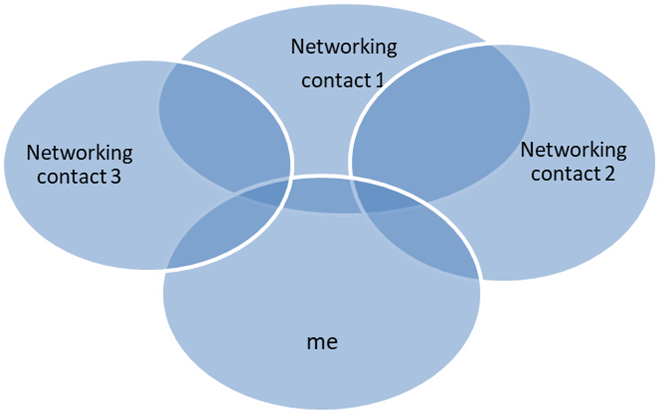
Ideally, this should result in networks, which define groups of people through a relationship to each other. Their purpose is to support each other, to offer help and to cooperate; but without the participation of people outside the network who could contribute a service or benefit from the activities of the network.
Figure 1: Overview of contacts
Source: ZiB-Draft
This systematization of the cultivation of contacts to the goals of mutual professional profitability is closely related to beneficial economic activities and therefore defines relationships in the sense of mutual, consolidated interaction, i.e. going beyond mere contact. From an economic point of view, cooperation should be initiated through networking. Only an active, densely interwoven network with qualitative contacts and frequent establishment of contacts brings advantages for both sides and ensures the effectiveness of the network in the long term. If this targeted networking has a positive effect on career opportunities, one speaks of goal-oriented networking or business networking, whereby the benefits of private relationships for the profession should not be ignored. This principle can be applied very well to events such as pitches (read more: News) and is therefore particularly relevant for start-ups.
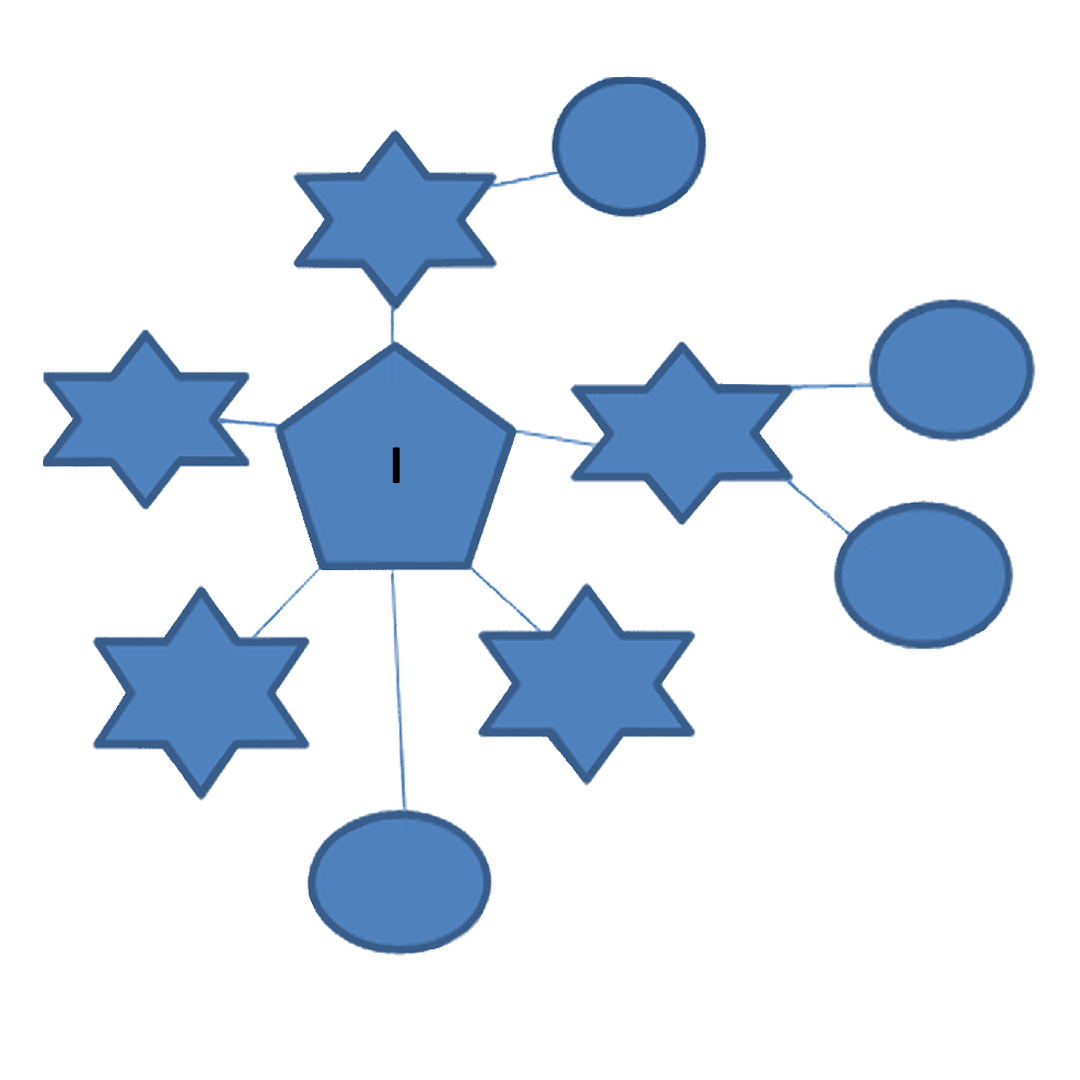
At the same time, the broadness of its radius of effect is achieved by networking via the principle that the contact of a contact is also a contact. This means not only using direct contacts, but a contact branches out and networks itself further independently. This networking takes place particularly efficiently via so-called agents, who gather a particularly large number of contacts around them and thus act as multipliers of contact for those who know one or more agents.
Source: https://www.deutschland-startet.de/gruenderlexikon-networking/
Figure 2 : My network
Source: ZiB-Draft
Tasks:
Underline the keywords
Put the keywords in a good order for you
Objective:
Understand the characteristics of social networks, get to know basic concepts and concepts of network analysis, develop the ability to visualize one's own networks and create an awareness of the potential of network visualization. Identify first steps in building a local network and identify potential challenges.
1.3. Are you a good networker? (Exercise)
How often are you in contact with "old buddies"? |
Points |
||
1x per month (3) |
1x in 6 months (2) |
1x per year (1) |
|
How much information do you reveal to your friends? |
|
||
What’s up! (1) |
Talking about good old times (2) |
Let them know about my life (3) |
|
How do you use your aquaintances? |
|
||
Congratulations on your birthday (1) |
Talk to each other regularly (2) |
Support each other, privately and professionally (3) |
|
Are you active in associations or clubs? |
|
||
I am a member, but hardly active (2) |
I am very active in several clubs (3) |
No time to join a club (0) |
|
Which of these qualities suits you best? |
|
||
Ability to work in a team (2) |
enjoyment of people (3) |
Inquisitiveness (2) None (0) |
|
How do you run your business network? |
|
||
Which network? (0) |
Business card must suffice (1) |
I try to maintain my internal and external networks (2) |
|
How many networking events do you attend each year? |
|||
Quite a few events (2)
|
a maximum of 3 important events (3)
|
if possible not at all (1) |
|
What are you doing Friday night? |
|||
Doing something with as many friends or ex-colleagues as possible (3) |
As always, listening to music, watching TV (1)
|
1-2 monthly meetings with friends and acquaintances (2) |
|
You're at an event and getting to know someone. How do you introduce yourself? |
|||
I mention my name, smile and go on (1) |
I smile, make eye contact and ask what the person is doing. (3) |
I smile, say hello and try to find a known person. (2) |
|
Sources: http://www.smi-seminare.de/blog/sind-sie-ein-guter-netzwerker
Result:
Up to 14 points: You have not yet realized the benefits of networks. You find it difficult to make new contacts and maintain them. In addition, you should think beyond the professional in conversations in order to establish a deeper connection.
14 to 23 points: You are already on a good path to networking. You should improve in some areas. What are your strengths? What are your weaknesses?
More than 23 points: You know what a network is/means, but you can still improve your network
1.4. Who should become part of my network? (Exercise)
Be creative in your choice. Anything is possible. Think big! |
|
Which 10 people would you like to meet personally? |
|
Which 10 social-media-contacts would you like to become personal contacts? |
|
Which 10 companies would you like to contact? |
|
Which 10 multipliers (e.g. people, newspapers, media) would you like to get in touch with? |
|
1.5. Which network is right for me?
With so many different networks, finding the right one or the right one is not an easy task. Therefore, every business founder should answer the following questions in advance:
Which goal or concern do I pursue?
Which members will I meet? Does this meet my expectations?
Which rules apply in the network?
What are the benefits of participating?
What commitment do I have to bring in and how much time do I have to spend? Am I ready for it?
How high are the costs?
How do I assess the chances of success with regard to my goals?
Are the venues easily accessible for me?
Of course, it is difficult to answer all these questions remotely. Therefore, it makes sense to gather as much information as possible about the networks. And best of all on site. Visit information events of the organizations you are interested in. In this way, you can get an idea of what it's like without having to fully participate in several networks - as a paying member. Otherwise, of course, the following applies: network in a private circle. This means: Do you know someone who is organized in a network? Then you should ask him to share his experiences with you.
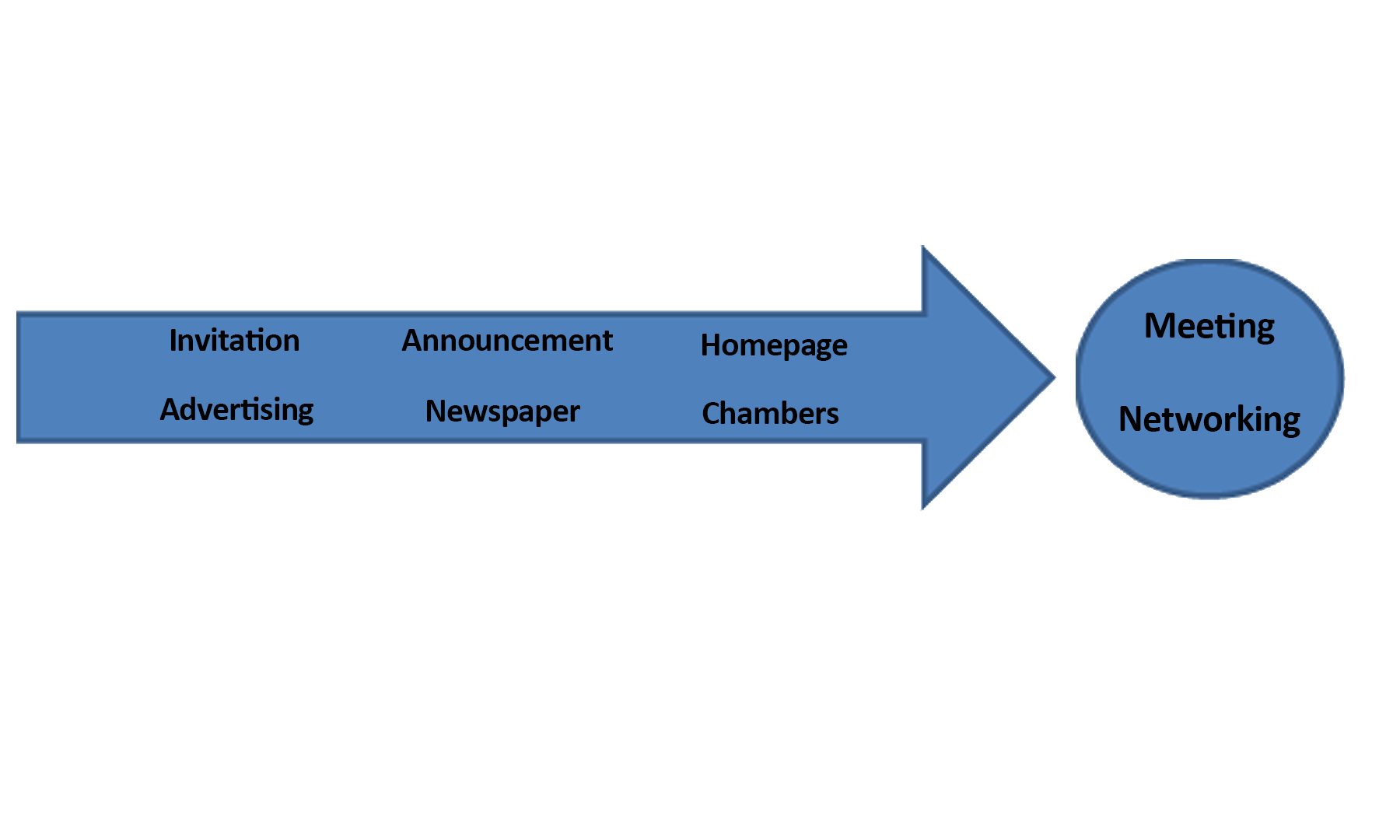
Figure3: Where to get business contacts
1.6. Basic rules for networking
Basic rules |
Please note! |
My considerations |
1.Preparation is important! |
Announce participation
Define goals in advance
|
|
2. First quality before quantity |
It doesn't depend on as many (superficial) contacts as possible, but on contacts in the sense of my start up: - Who can be important for me? - Be already present at the welcoming / input presentation of events |
|
3. Objective of networking |
Who am I looking for? - Experts/expert exchange - Suggestions / new ideas - Problem solutions - Potential customers / suppliers |
|
4. Give > Take |
- 70% give - 20% present - 10% take |
|
5. Networking is long-term |
- Maintaining and expanding contacts |
|
6. Behaviour during networking |
- Smalltalk - Active communication, i.e. addressing (interesting) people yourself - Accept/express invitations (e.g. trade fair stand, company tour...) - Body language: open, friendly, interested, eye contact - Ask questions, stay in touch - Business cards!!! - Create and hold connections - Find out what they have in common |
|
Source: https://bilei.com
2. Networking Plan and strategic aspects
Networking is a means to an end. But which goals are to be achieved through networking? Here are the main questions you need to ask yourself when setting up a networking plan.
What contacts do you need to start a business?
Which social media channels do you want to use?
Which networks would you like to actively participate in?
Are there any network events in which you would like to participate?
What is your budget for networking?
How much time and effort do you want to invest in networking?
What recommendations do they currently need?
2.1. Some aspects of networking strategy
Do you want to strengthen and expand your network? Plan this project like a project. Set yourself clear goals and develop the network strategy that suits you best. Stay tuned!
Status-quo: Which of your existing network partners can provide you with special support when setting up your own business?
Elevator Pitches: Short presentation of yourself, your expertise - what makes others curious to get in touch with you?
Optimization of presence (online and offline media): Present yourself professionally (e.g. business cards, flyers, social media profile). Pay attention to the quality of your self-presentation!
Networking is part of business life and everyday life. Use every opportunity to network.
Maintain your existing contacts. Use (every) opportunity to stay in touch. Can they be useful to their network partners or even act as problem solvers?
Principle "give and take": If they bring people together, they strengthen their network in the long term for mutual benefit.
2.2. Social and solidary economy
In his lecture, Prof. Gert Scobel names three major societal challenges: complexity, digitalisation and the common good.i The technological challenges can be described by three terms: Digitalisation, Artificial Intelligence and Robot Technology. What does this mean in detail? The equipment of hardware and software is of great importance for both business and private work in the sense of the term, as is external communication and cooperation. IT security and data protection must be secured both in companies and at external workplaces (home office). Cooperation (internal/external) will still increase (see Blockchain).
For individual workers, the technological challenge means maximum flexibility (location, time) and new forms of work-life balance. Agility and qualifications (lifelong learning) are prerequisites for a minimum level of employment security.
What are the consequences?
Pessimistic assessments assume that a large part of the simple and repeatable activities will disappear and that unemployment can become a social problem. In this context, more recent considerations on the solidarity-based economy and the sharing economy are gaining in importance - also for start-ups.
Solidary economy is a form of economic activity in which money as a means of valuation and payment is completely or partially replaced by other processes or agreements. It uses elements of corporatism and syndicalism. The phenomenon is investigated in the social sciences - economics, sociology and political science.
Solidarity-based economics refers to needs-oriented, social, democratic and ecological approaches. Solidarity-economic projects should basically serve people. Furthermore, it is often based on the conviction that every human being is part of society and that his or her work is an essential part of human progress.
Figure 4 : The world of social entrepreneurship

Source: http://www.secumbria.org/
Solidarity economic projects exist in many regions and forms of society, for example in Latin America, but also in Europe. These include open source software projects and alternative educational institutions, swap platforms, repair cafés, social markets, for-free-shops, self-governing businesses and flat-sharing communities.
The projects and models often pursue goals in three fields:
Social objective: The community should be democratically and socially ordered. Materialism is to be overcome and the individual reintegrated into social life.
Political goal: Co-determination and democracy should be expanded. The aim is to create a kind of solidarity community that sees itself as a system of values and norms that focuses on the individual.
Economic objective: Living and working conditions should be improved without borrowing. Various efforts such as the conservation of natural resources, sustainability and needs-based management are part of this. If necessary, human-induced impairments or damage should be repaired. The economic objective overlaps with the political and social objective.
New social movements are also mentioned in this context. In them, people are also engaged against the consequences of globalized capitalism, but above all against exclusion, marginalization, precarisation, unemployment and poverty. They come together and try to work with other economic models.ii
i https://nrwschool.de/2018/10/24/ challenges-by-new-technologies-public-lecture-by-prof-gert-scobel/, last accessed: 24.11.2019.
2.3. Sharing Economy (Definition)
The term Sharing Economy (also "Shared Economy") means the systematic lending of objects and the mutual provision of objects, spaces and areas, in particular by private individuals and interest groups. The term "share economy" is used synonymously or - in addition to Martin Weitzman's original definition - in relation to the sharing of information and knowledge.
According to the idea of the economy of sharing, the buyer should not turn something into property, but should temporarily use, inhabit and manage it. The prerequisite for this is, of course, usually the ownership of a supplier. The focus is on collaborative consumption. The goods change hands as long as they are needed or available. Maintenance is usually the responsibility of the owner.
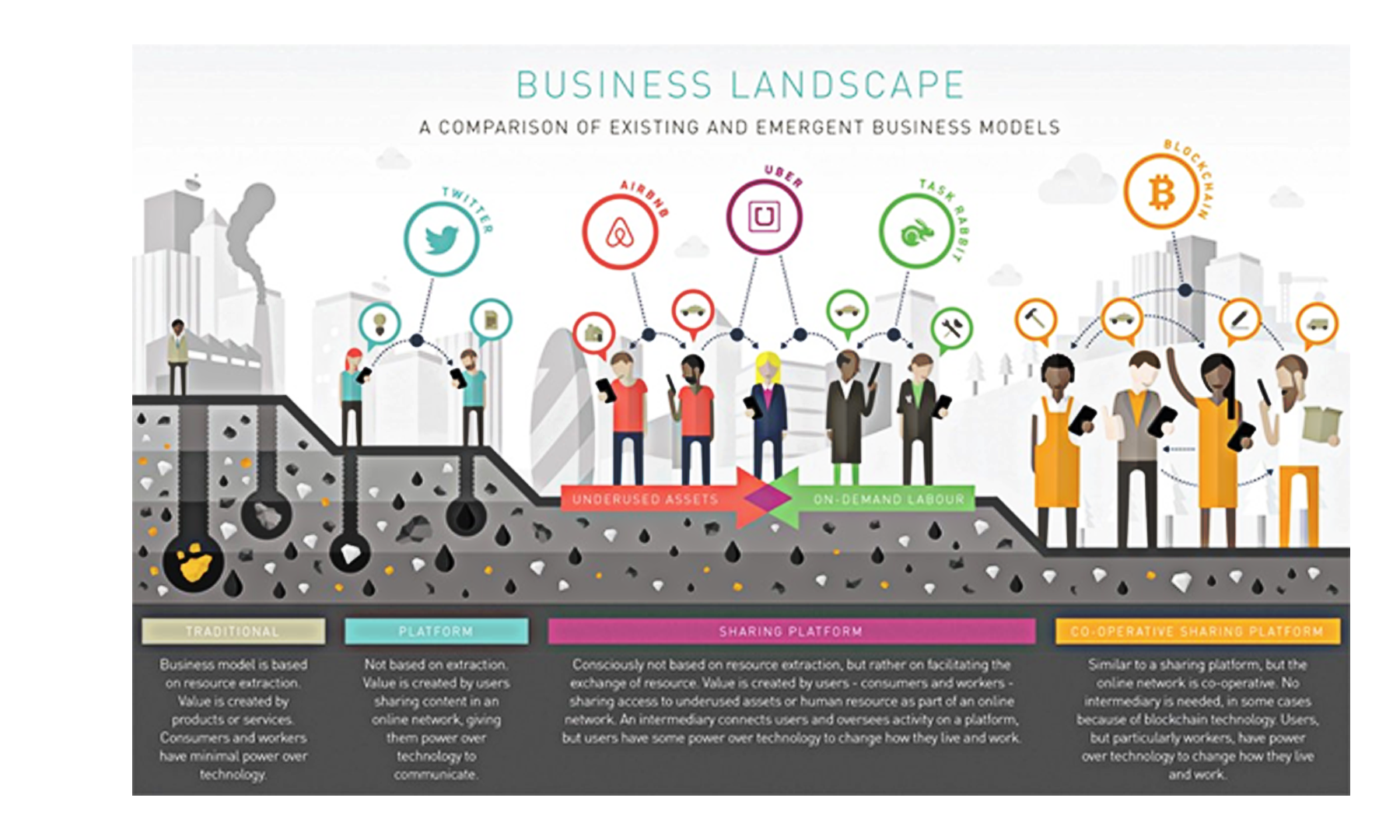
With electronic platforms and social networks one reaches a large circle of interested parties, can act and react at short notice and achieve optimal use and utilization. Some platforms are specialized in apartment sharing and land sharing, others enable variants such as book and jewellery sharing. Also exchange and gift exchanges belong to the hardly to be surveyed landscape. With the help of social media functions, demanders and suppliers are evaluated and vandalism and abuse are sanctioned.
The economy of sharing is viewed critically by the economy on the one hand, and used productively on the other. Car sharing, for example, is extremely popular in some countries and in the hands of cooperatives and companies. In addition, private cars are converted into public taxis and apps bring drivers and guests together. With regard to users, the criticism is that it is predominantly those who have access to the virtual world who also gain access to the Sharing Economy, which, with the terms of information ethics, means a digital divide or digital or informational injustice. With regard to the intermediaries, it is striking that they can shake entire industries through their platforms alone, without owning their own homes, vehicles, content, etc.. This "platform capitalism" (Sascha Lobo) can be addressed by information and business ethics. On the positive side, the environment is protected and consumption becomes more conscious and social. The Sharing Economy receives a boost in times of crisis; at the same time it should be an expression of the experience and fun society.
(Source: https://wirtschaftslexikon.gabler.de/definition/sharing-economy-53876)
Figure 5 : Change of Business Landscape
Source: https://medium.com/rsa-reports/fair-share-reclaiming-power-in-the-sharing-economy-499b46bd4b00
More information:
A cooperative is an autonomous association of persons united voluntarily to meet their common economic, social and cultural needs and aspirations through a jointly owned and democratically controlled enterprise.
Source: https://www.ilo.org/global/topics/cooperatives/lang--en/index.htm
3. Networking as a social entrepreneur
A social entrepreneur is an entrepreneur
- who seeks to accomplish an unsolved social task (theory of change),
- who does not strive for financial profit, but for social success (social impact),
- whose values are based on democracy, human dignity and sustainability (compliance),
- who acquire the necessary human and social resources (capacity building),
- and can represent this in a business model.
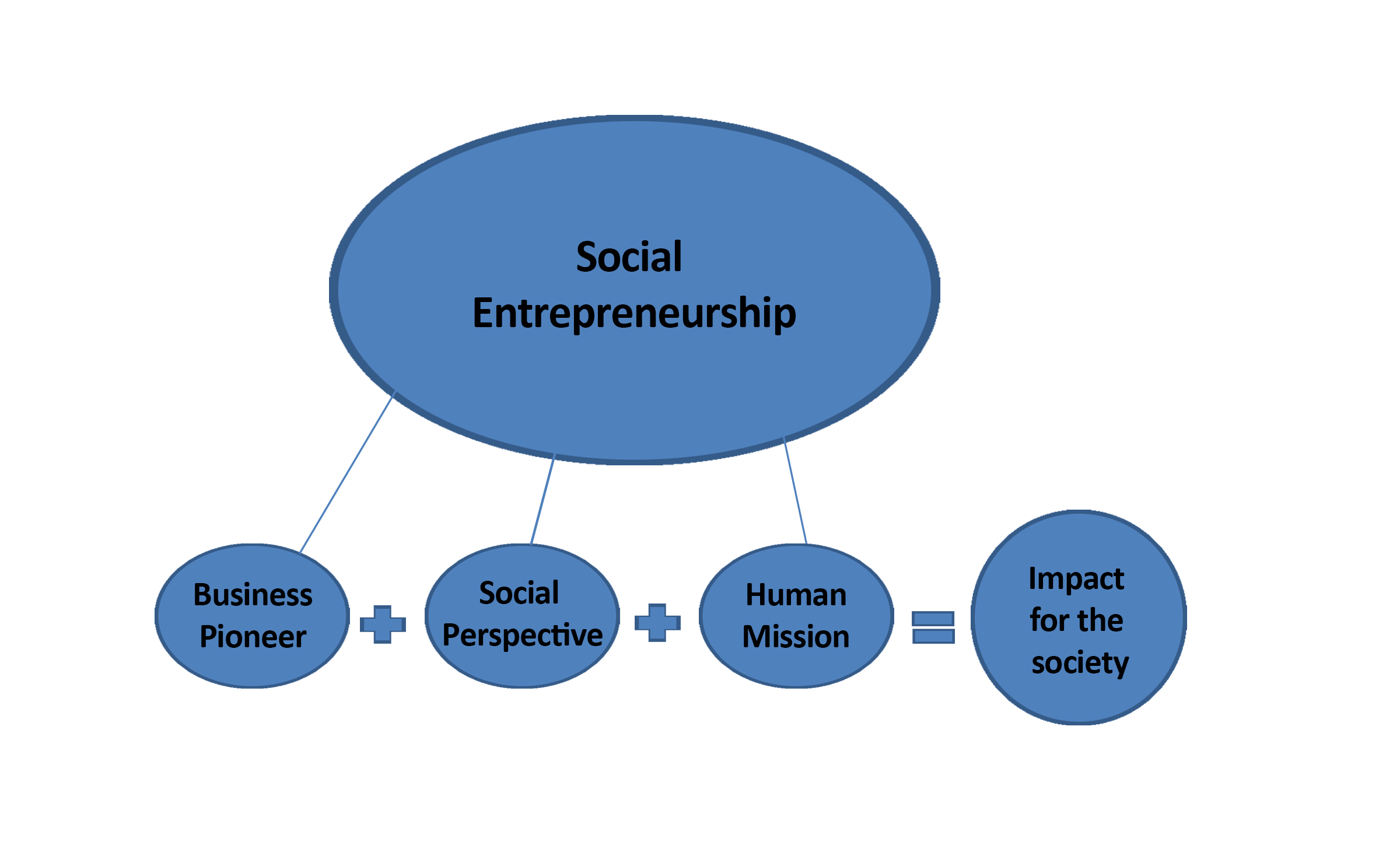
Taking this definition of social entrepreneur into account, a business start-up needs a network that includes economic, social, societal, political and ecological aspects. This means a great communicative and cooperative ability to collaborate with other people and institutions.
Figure 6: Social Entrepreneurship
Source: ZiB-Draft
3.1. Networking and Social Media
Turn personal contacts into virtual ones and virtual contacts into personal ones! Find the right mix of offline and online activities. Networking with personal contacts online has the following advantages:
- you are able to stay in touch more easily,
- you are always up to date,
- you remain present and
- you reduce the expenditure of time and money.
Social media bring people together who would never meet in real life and social media are open to new contacts. Where ever you or your contacts are, you are connected all over the world. What opportunities do social media offer for start-ups and social entrepreneurs? You are able to use social media as:
Marketing instrument (branding, product marketing, market research) and/or
Communication instrument (customer acquisition, customer loyalty, customer service, customer support, information source, further education and training)
But maybe you ask yourself: Which platform is right for me? Some insights as to how to use Social Media for marketing, we already provided in Unit 3. Here are some more hints as to which platform might be right for you for networking.
There are many different social media platforms that can be used for private and/or business purposes. We do not want to advertise or make recommendations at this point. Details, user conditions, data protection etc. can be found in the respective business platforms. Which platform is suitable for me? What do the platforms offer and which target groups do I want to reach?
Short overview of the most popular platforms
Community Management; Development of the brand; product marketing |
|
Snapchat |
Young target group; Exchange of photos, films, videos and information |
Formation of groups; exchange of information, appointments, etc. |
|
Product marketing, expansion of the corporate brand |
|
Blog marketing ; media work; PR |
|
XING or LinkedIn |
Formation of expert groups; development of corporate brand; show your own skills and qualifications; sales |
YouTube |
Video marketing, community management |
There are some main things you need to consider
when using a platform:
- Create a profile that is correct and up-to-date. Your online-profile is your business card!
- Your personality works best with a professional photo.
- Check the settings for the social-media profile (privacy setting)
- Update the contents regularly
- Quality before quantity
- Observe legal requirements and data protection!
- Use the data and statics provided by the platforms.
Develop your own social-media-strategy: See the advantages of social media; targets, target groups; choose the right canals; think about photos, text, video, podcast; use a schedule; look for inspirations; connect your network activities.
Consider possible risks and how to deal with them:
Shit storm
Warning letter
Which data and information are public, private or only accessible to certain groups?
Data abuse: Viruses, Trojans and Data Theft
3.2. Networking means more than just digital networks.
When I talk about visibility in networks, I mean much more than just digital platforms. These are certainly an important instrument, especially when it comes to international networking. But even today, networking plays an important part in the "real" - that is, analog - life. Perhaps personal contact is even more important today than it was before. Especially in a market environment, companies whose values and culture are lived by the social entrepreneur and make this publicly visible are often awarded the contract.
By visibility I mean, for example, a stronger presence at events, participation in panel discussions and the regular maintenance of personal contacts. Visibility can also be understood through a targeted communication strategy. Those who actively set future topics and drive them forward are increasingly perceived as agenda-setters in discourses.
Questionaire: Self-assessment questionaire networking |
Yes |
No |
Do you have the necessary support from family, relatives and friends? |
|
|
In general, do you think networking makes sense? |
|
|
Do you like to go to professional events? |
|
|
Did you have much to do with people in your previous activities? |
|
|
Have you contacted former classmates, colleagues or other people? |
|
|
I like to approach people and get into conversation easily. |
|
|
Are you part of a social network (e.g. XING, LinkedIn, Facebook, Twitter)? |
|
|
Do you regularly attend events for networking purposes? |
|
|
Are you an active part of a community (e.g. sports team, choir, theatre)? |
|
|
Do you like to approach people? |
|
|
Do you know the 5 basics of networking? |
|
|
Do you know the 5 biggest mistakes in networking? |
|
|
Have you thought about a strategy for networking? |
|
|
Have you found the networking information helpful? |
|
|