
Ice breaking excercises
1. Flower
Participants are divided into groups of minimum 3 persons. Each group on a piece of paper will draw a flower consisting of a large measure and as many petals as there are participants. Participants must ask themselves questions to find out their common things and unique things that differentiate them from other people in the group. Then participants should write in the middle 3 features that are common to all of them, and in petals 3 attributes that are true only for a given participant. Then flowers are presented to the forum.
The features should relate to the intercultural subject, diversity etc., e.g. who has got ancestors from a different country? Who has got in their family a person from abroad? Who likes to travel? Who has travelled abroad for work? There may be information about repatriates, migration after war, but also about religion, traditions, dialects used etc.
This task sets the mind in a positive way to diversity showing that everyone of us may come from different cultural backgrounds or may have different beliefs and different traditions, but at the same time we all share common values, features etc.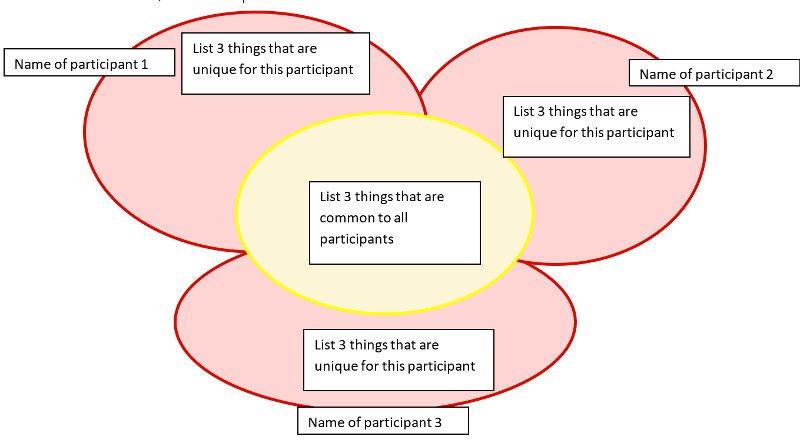
2. Learning about people in the group
Each participant gets 4 sheets of paper. On each of the sheets participants should write 1 true fact about themselves and on the 4th sheet should write made up thing about themselves.
Participants receive 4 chocolates. At the time of exercise, each person is asked questions in order to determine which of the sentence is false. Participants vote and place the chocolates they received on the participant false answer. Participants can bet four chocolates with one answer or split chocolates for each answer. After completing a series of questions each participant reveals what the false statement. The chocolates that were placed on the correct answers remain with the given participant, and those who were placed on a false statement land in a common pool.
3. Gifts giving
Participants are being divided in pairs. One person from the pair is a recent immigrant, the other is local. Local person gives the other an imaginary gift. The recipient (immigrant) opens it and then he says: "Oh! xxxxxxxx " (recipient must name the imaginary gift – it should be something that immigrant needs to have a better life in the new place).
The donor (local person) replies: "I give you xxxxxxxxx because ............."
xxxxxxxxx, this is the subject that comes first to the recipient’s mind.
Then there is the change of pairs and the same action is performed with the person sitting on the other side. (first on the right, then on the left). This can be repeated any number of times.