
Lesson 1: Cultural and ethnic diversity in Europe
Recommended size of the group: min. 6
Aim of the lesson:
To introduce the subject of diversity in Europe by presenting facts and figures and give the background of the cultural and ethnic diversity in Europe.
To consider the reasons behind migration and to appreciate of the freedom to relocate/to choose the place to stay.
Objectives / learning outcomes:
To set people minds to thinking about migration in a positive way.
To be able to use the 6 thinking hats method to assess the information by critical thinking and make opinions by assessing all aspect of a matter.
Resources needed: Paper and pens, separate cards with 6 hats on it and on the reverse side of every card the description of the hat’s symbolism. They are needed for learners to have an easy access to their hat description and also to make notes while they are preparing their tasks.
Teaching method to be used in the lesson: lecture, group work, discussion
Content
“Every human is like all other humans, some other humans, and no other human” — Clyde Kluckhon[1]
Migration can be defined in the EU context as “the action by which
person either:
- Establishes his or her usual residence in the territory of a Member State for
a period that is, or expected to be, of at least twelve months, having
previously been resident in another Member State or a third country; or
- Having previously been resident in the territory of a Member State, ceases to
have his or her usual residence in that Member State for a period that is, or
is expected to be, of at least twelve months.
In Global context, this refers to a process of moving, either across an international boarder (international migration), or within a state (internal migration). It is population movement, encompassing any kind of movement of people, whatever its length, composition and causes; it includes migration of refugees, displaces persons, uprooted people, and economic migrants”.[2]
Migration as a social or economic phenomenon is natural and born of specific social problems therefore we can distinguish migrants due to economic reasons, high-skill workers demand, environmentally-driven, forced, seasonal, long-or short-term. Mobility and movement have long accompanied mankind having economical foundation (searching for resources) or was associated with rivalry and conflicts. Through the European history both immigration and emigration has had a vast influence on the current European culture and ethnicity.
Taking an example from Polish history there was a mass migration after World War II. Many people fled to the US to avoid consequences after the guerrilla service. After 1990, many people travelled long or short-term to western countries for economic reasons. Poland is also the destination country for people who were once resettled to the USSR, and now they and their children are trying to return as repatriates. In order to assess migratory claims, statistical evidence is also examined to support both sides of the political argumentation. We, as recipients, must judge ourselves which are correct or the most accurate. The way in which data is interpreted depends on the perspective of one of them.
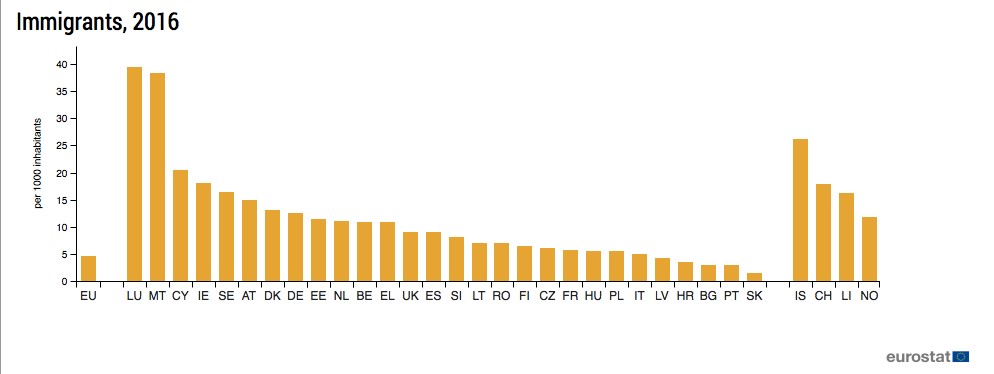
In 2016 two million non-EU citizens emigrated to the EU and Member States granted citizenship to nearly one million people. Out of the member states Germany reported the largest number of immigrants (1 029.9 thousand) in 2016, then in the United Kingdom half as many, then Spain France and Italy. Numbers can also be analysed in relation to the resident population and in this case, Luxembourg recorded the highest immigration rates in 2016 (39 immigrants per 1 000 people) - please see graph above.
We need to also remember that EU countries record emigration and here for emigration also the highest rates. In 2016 Luxembourg were recorded (23 emigrants per 1 000 people), then Malta, Lithuania and Cyprus (all with 18 emigrants per 1 000 people). [3] In total, 21 EU Member States reported more immigrants than emigrants in 2016.
Returning to the times after the Second World War, Europe provided shelter for repatriates leaving former colonies, as well as from countries such as former Yugoslavia, and more recently also from Afghanistan and Syria. In many European countries more people come than they leave. Immigration is higher in economically prosperous countries. [4]
TASK:
At the beginning of the session the trainer should use the text provided to introduce the migration subject and give the rough statistics depending on the group /country that can be found on the Eurostat website. Every learner should choose one hat either by drawing randomly or by choice. In the course of the task every learner is responsible for providing the insight to the discussion as per hat colour. If there are more than 6 learners those who have the same colour of the hat should work together in pairs or groups. The pictures with hats and the descriptions can be printed and handed out to learners. Trainers should observe and moderate discussion as at the beginning it may be difficult for learners to keep thinking as per colour of the hat. Based on the text from the introduction learners should have 15 minutes to consider the task given below.
Situation to consider:
“The great revolution in the history of man, past, present and future, is the revolution of those determined to be free.” - John F. Kennedy (35th President of the United States).
There are different reasons for migration. In our area we also observe the constant movement, known from one’s own life, family, neighbours, local society, press, TV, and global situation.
The neighbouring country is under the pressure of power seized by force and imposes ever new restrictions. Residents of this country not accustomed to such situations and are asking for asylum and admission to your country. Your country is prospering, but so far it was not open for foreigners and citizens are not used to the presence of other nationalities and cultures. Your county is very monogenic. Your parliament is trying to make the plan for admission and integration. As members of local parliament, you need to decide the best solution to the situation described above.
Using six thinking hats method please assess the below mentioned options:
1. Allow the immigration slowly and create one region/area for them, where they can be protected. At the region/area language lessons, cultural lessons will be offered, and schools will be organised.
2. Allow the immigration and place immigrants separately within the local communities in order to let them immerse in the local society by participating in life of citizens.
At the end of the exercise the trainer should summarise the discussion and underline the positive aspects of the discussion and conclusion in order to leave learners with the positive feelings and attitude.
Evaluation of lesson
The feedback should be given anonymously. Every person should
receive sticky notes. One note should provide only one piece of information.
The feedback should be given on the content of the task, of their feelings
after doing the task, feelings toward migration (positive, negative etc.) after
completion of the task, and any general comments that learners should like to
share.
Then all the sticky notes should be placed on the board, read aloud and
grouped. Trainer should read them aloud and ask learners to comment if they
wish. Trainer should summarise at the end, leaving learners with the positive
thought.
General tips for the trainer
The minimum number of people is six as there are six thinking hats, so one person should think of one hat only. However, if there are less participants, one person can be assigned with 2 hats and perform thinking from each hat perspective.
The task duration is about 60 minutes.
When giving presentation of the main migration points and direction every trainer should be able to adjust to their audience and emphasise their national background.
[1] Clyde Kluckhon (11/01/1905-28/07/1960) was an American anthropologist and social theorist, best known for his long-term ethnographic work among the Navajo and his contributions to the development of theory of culture within American anthropology.
[2] Asylum and Migration Glossary - A tool for better comparability - produced by the European Migration Network,January 2010, page 98