
OPENING UP PATHS
Objective
Up to now, you have worked with students to analyse their motivations and values, discover their talents and identify their personal and professional interests. All of this has provided them with a suitcase for the trip filled with all the resources they already have to embark upon the pathway. In this section, you want to help them determine: where they are headed towards. To do so, we suggest that you help them to identify their professional projects. This in turn will help them to set goals, adding the contexts of social vulnerability with the aim of identifying opportunities and possible threats.
This will all prepare them in defining a pathway that provides them with a working plan in order to keep moving towards the professional projects they aspire to.
Description
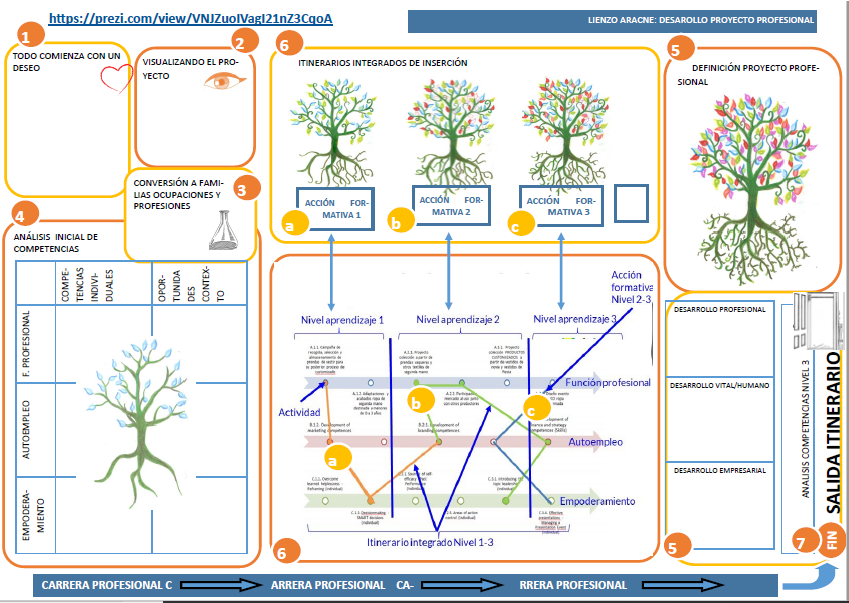
It is now time to return to or start, as applicable, analysing professional interests, which was approached in steps 2 and 3 of the ARACNE Canvas, visualising their professional goals and converting them into professional interests.
Visualising: Identifying their professional preferences and interests is a key step within the process of career guidance.
Working with what they like will contribute to their wellbeing and will ensure that they offer the utmost expression of their talent and potential.
Their interests are everything they like to do, regardless of whether it is a physical, intellectual or creative activity, or one of another nature. Their interests will determine their professional choices.
To detect them, they should observe which occasional personal characteristics give them pleasure, what catches their eyes, what is entertaining to them, etc., not thinking about specific occupations or financial considerations or the pros and cons of any one choice. They should keep these factors separate at this time.
During this activity, your students should find some indications to discover their interests and relate them to real professions with future prospects.
To set a professional objective, it is important to know all participants’ main potentials. You could use Gardner’s Multiple Intelligences Theory, which Ken Robinson called the ELEMENT: the place where the things we like to do and the things we do particularly well intersect.
Conversion: After you have explored with your students what they want and what they do well, it is time for them to specify a work activity, meaning a job post. Knowing different professional families and their qualifications will let you go into greater depth on which competences are necessary or need to be acquired to practice a specific profession (what we have called professional function in the Aracne+ model) and subsequently design a work plan (pathway).
Professional project: Personal and professional projects fit together in the majority of cases.
What is a project? It is a mapped-out plan, a framework for living that fits a person’s order of priorities, values and expectations, in which the person – as owner of his or her destiny – decides how he or she wants to live. This project is directly linked to self-realisation and wellbeing, and is the source of motivation for people who are aware of what they want and fight to get it. A project must consider how well it fits with events that occur. For adults, you should remember that it may be beneficial at any time for them to redefine their professional project.
With regard to content, remind them of the importance of identifying not only their technical and professional competencies, but also those for empowerment and entrepreneurship on their profiles.
The professional or job post profile can be constructed by conducting interviews with dedicated professionals, analysing professions… This will give your students information on the functions, tasks, tools, required skills, values and interpersonal dynamics with others. It is important to identify technical and professional competencies, but also those that students identified in the areas of empowerment and entrepreneurship.
Career
Comprised of a series of jobs, work and non-work experiences, paid and unpaid, and training and preparation activities that take place over the course of their lives. To the degree that this permits progression, a recognised competency development supported by degrees and objectively-recognised professional categories is what we speak of as career development.
At present careers can be interrupted by a multitude of factors (emigration to a country with a different certification system, life conditions that force one to temporarily leave the job market, illnesses or accidents that put a stop to specific professions, redundancy proceedings at companies, etc.)
A career that is interrupted in adulthood tends to mark the onset of exclusion from the job market.
The ARACNE Model advocates career development in adulthood as a conscious and planned decision for people as a means to overcome precarious jobs.
Social vulnerability
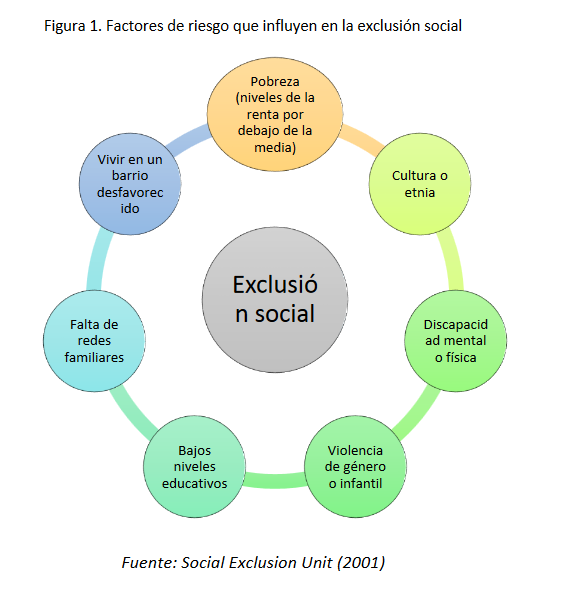
Social exclusion is a process of people’s loss of integration or participation in society in different economic, political and social areas (PNAIN, 2013). Factors including education, employment, housing and health are determinants in social exclusion processes and affect different population sectors either in isolation or combination, particularly the most vulnerable groups. In these cases, people may find it more difficult to assess their own competencies and detect opportunities due to being deeply affected by their social and employment situation.
Development and methodology
Materials
1) ESCO is the European multilingual classification of capacities, competencies, qualifications and occupations, which is part of the Europe 2020 strategy. ESCO classification determines and categorises the pertinent capacities, competencies, qualifications and occupations for the EU job market and education and training. It systematically displays the relationships between the different concepts: https://ec.europa.eu/esco/portal/qualification
2) Find out the professional families and training for employment in your country: http://incual.mecd.es/europa
3) Spain is detailed at this link: http://incual.mecd.es/
4) Look at the graphics below that describe the risk factors that influence social exclusion and their main identifiable groups. Reflect: Does the same classification system exist in your country? Can you identify other groups?
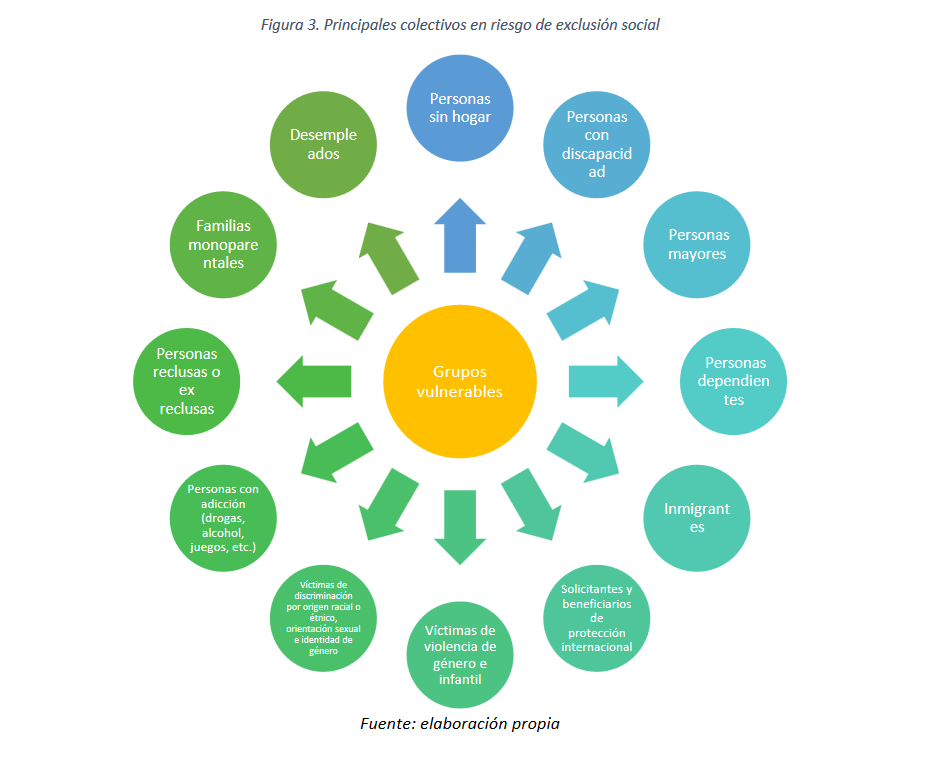
5) Now that you know the features that make people’s careers more difficult or easier, know how to identify situations of social vulnerability and know the entrepreneurship and empowerment competencies from the Aracne Model, we suggest an activity in which you can put your knowledge to the test.
In the video, four people talk about their successes and failures in their professional project. Pick one of the cases and answer these questions:
Play video
Objective
Identify the main elements that facilitate or hinder a person’s career.
Analyse
Identify which barriers, determinants and contexts that may have influenced the person entering or having entered a situation of social vulnerability.
With respect to the four cases studies, how many groups at risk of social exclusion can you identify?
Reflect
For the case you picked, which competencies does the person have? Which of them do you identify as facilitators in the Aracne+ Model?
Challenge
For the case you picked, do a SWOT analysis and move it over to activity 1: ‘The Competency Tree’ identifying the Aracne competencies, situations of social vulnerability and features that lead to career development and employability.
Length: 60 minutes
For further work:
The materials below are optional.
1) If you need materials to work with your students and help them to determine their professional interests and focus on a professional family, we provide these links for you:
https://orientadorespalencia.wordpress.com/2013/05/31/tests-de-autoevaluacion-de-competencias-laborales-y-preferencias-profesionales/
https://drive.google.com/file/d/1kC2_mGvCziSsBQEanUzxE4fQANc-b3g9/view?usp=sharing
2) Would you like to delve further into how to discover your passion? Watch this video that speak of ‘The Element’:
Play video
3) Would you like to know about the Theory of Multiple Intelligences?
Play video
4) Do you need a guide for CAREER GUIDANCE FOR VULNERABLE GROUPS? We recommend that you read chapter 1.
https://www.google.com/url?sa=t&rct=j&q=&esrc=s&source=web&cd=2&cad=rja&uact=8&ved=2ahUKEwjD3u3Vq4bfAhVqJcAKHTxnDecQFjABegQICBAC&url=https%3A%2F%2Fwww.ccoontigocampus.es%2Fdescargar-doc.php%3Fid%3D56%26obj%3Ddocumento&usg=AOvVaw2Hiu_4wOHVIkqdkV3e0aOJ