
Rețele și parteneriate locale
2. Networking Plan and strategic aspects
2.2. Social and solidary economy
In his lecture, Prof. Gert Scobel names three major societal challenges: complexity, digitalisation and the common good.i The technological challenges can be described by three terms: Digitalisation, Artificial Intelligence and Robot Technology. What does this mean in detail? The equipment of hardware and software is of great importance for both business and private work in the sense of the term, as is external communication and cooperation. IT security and data protection must be secured both in companies and at external workplaces (home office). Cooperation (internal/external) will still increase (see Blockchain).
For individual workers, the technological challenge means maximum flexibility (location, time) and new forms of work-life balance. Agility and qualifications (lifelong learning) are prerequisites for a minimum level of employment security.
What are the consequences?
Pessimistic assessments assume that a large part of the simple and repeatable activities will disappear and that unemployment can become a social problem. In this context, more recent considerations on the solidarity-based economy and the sharing economy are gaining in importance - also for start-ups.
Solidary economy is a form of economic activity in which money as a means of valuation and payment is completely or partially replaced by other processes or agreements. It uses elements of corporatism and syndicalism. The phenomenon is investigated in the social sciences - economics, sociology and political science.
Solidarity-based economics refers to needs-oriented, social, democratic and ecological approaches. Solidarity-economic projects should basically serve people. Furthermore, it is often based on the conviction that every human being is part of society and that his or her work is an essential part of human progress.
Figure 4 : The world of social entrepreneurship
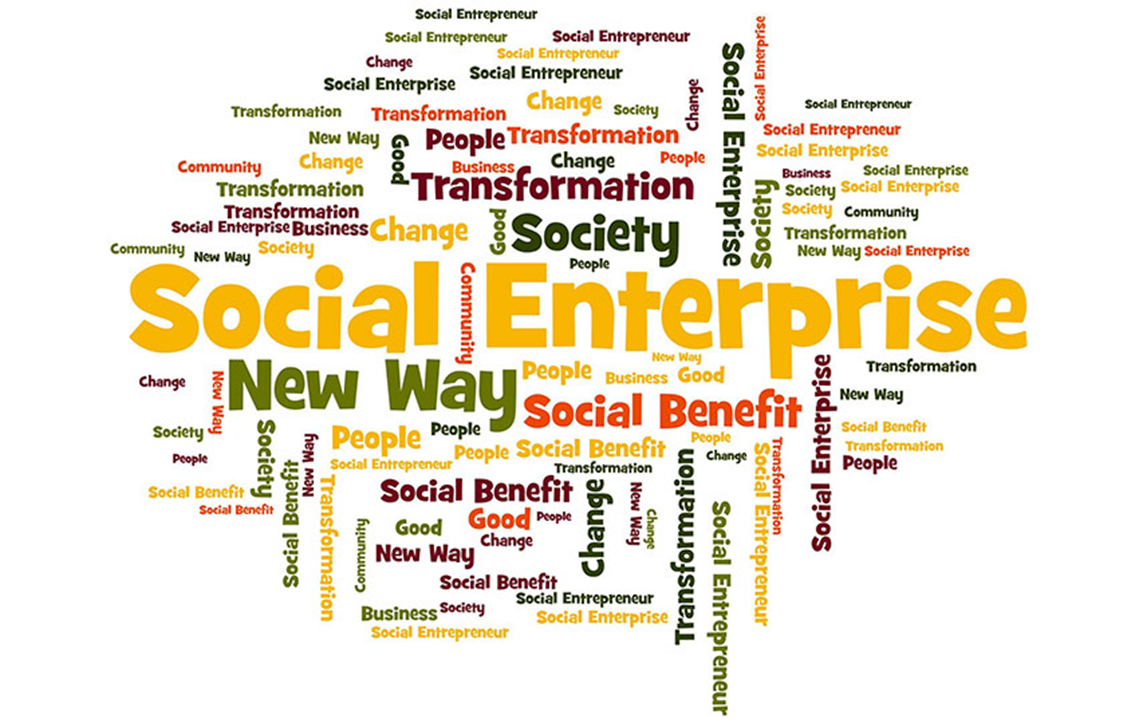
Source: http://www.secumbria.org/
Solidarity economic projects exist in many regions and forms of society, for example in Latin America, but also in Europe. These include open source software projects and alternative educational institutions, swap platforms, repair cafés, social markets, for-free-shops, self-governing businesses and flat-sharing communities.
The projects and models often pursue goals in three fields:
Social objective: The community should be democratically and socially ordered. Materialism is to be overcome and the individual reintegrated into social life.
Political goal: Co-determination and democracy should be expanded. The aim is to create a kind of solidarity community that sees itself as a system of values and norms that focuses on the individual.
Economic objective: Living and working conditions should be improved without borrowing. Various efforts such as the conservation of natural resources, sustainability and needs-based management are part of this. If necessary, human-induced impairments or damage should be repaired. The economic objective overlaps with the political and social objective.
New social movements are also mentioned in this context. In them, people are also engaged against the consequences of globalized capitalism, but above all against exclusion, marginalization, precarisation, unemployment and poverty. They come together and try to work with other economic models.ii
i https://nrwschool.de/2018/10/24/ challenges-by-new-technologies-public-lecture-by-prof-gert-scobel/, last accessed: 24.11.2019.